

The Hidden "Negative Pressure" Skill of Side Channel Blowers: Can They Replace Small Vacuum Pumps?
In the industrial field, when people mention Side Channel Blowers (also known as Regenerative Blowers or Ring Blowers), the first impression is usually "blowing air"—aerating fish ponds, drying water droplets off bottles, or wastewater treatment aeration.
Brands like Gardner Denver, Elmo Rietschle, Elektror, and NASH are standard names when discussing high-pressure blowers, centrifugal fans, liquid ring pumps, and vacuum pumps.
But you might not know that the Side Channel Blower has a hidden talent: It acts as a high-flow "Vacuum Pump."
Many factories overlook this more economical and durable option when purchasing expensive rotary vane or piston vacuum pumps. So, the question arises: Can a side channel blower truly replace a vacuum pump? How strong is its "negative pressure" capability?
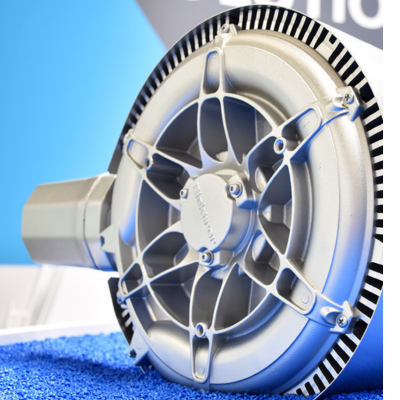
1. Technical Reveal: Why Can a Blower Create a "Vacuum"?
To understand this, we must look at its working principle.
The core of a Side Channel Blower is its turbine-like impeller. When the impeller rotates at high speed, air is thrown outward by centrifugal force, forming a series of spiral vortices within the pump housing. This special channel design causes the air to be compressed multiple times during each rotation.
This structure creates two distinct characteristics:
Blowing (Positive Pressure): High-pressure airflow is discharged at the outlet.
Suction (Negative Pressure): To replenish the expelled air, a powerful suction force is created at the inlet.
This is the source of its "vacuum." Unlike traditional vacuum pumps that rely on pistons or vanes to physically seal a space, side channel blowers rely on high-velocity air to carry air away.
2. The "Highlight Moments": When Side Channel Blowers Can Replace Vacuum Pumps
Not all vacuum requirements need "absolute vacuum." In scenarios requiring "imperfect sealing" or "high flow suction," side channel blowers can not only replace traditional vacuum pumps but often perform better:
1. Vacuum Lifting & Handling (Suitable for Permeable Materials)
Scenario: Robotic arms gripping cardboard boxes, wood, foam blocks, or marble.
Why choose it: Traditional vacuum pumps fear leaks. If the suction cup attaches to a rough or slightly permeable material (like cardboard), air constantly leaks in. Traditional pumps have low flow rates; once a leak occurs, the vacuum level drops instantly, and the item falls.
Advantage: Side channel blowers have massive flow rates. Even if the suction cup edge leaks, the blower instantly compensates with its huge air volume, maintaining negative pressure and holding the item securely.
2. Screen Printing & Paper Fixing
Scenario: Printing machines holding paper onto rollers or cutting machines fixing fabric.
Why choose it: The goal isn't to remove all air, but to create a pressure differential to "press" the object onto the worktable.
Advantage: The suction is moderate—it won't tear thin paper—and provides continuous, uniform holding force.
3. Industrial Extraction & Central Dust Collection
Scenario: Textile mills removing thread waste; electronics factories removing dust.
Why choose it: This is typical "pneumatic conveying."
Advantage: Vacuum pumps cannot handle large amounts of dust (it clogs or damages oil circuits). Side channel blowers are simple, oil-free, and, when paired with a filter, are the perfect power source for negative pressure conveying.
4. Dental & Medical Suction
Scenario: Saliva ejectors next to dental chairs.
Why choose it: Needs to quickly suck away liquids and aerosols while being oil-free and hygienic.
Advantage: Usually oil-free operation, clean, and high flow. It won't fail just because it inhaled some liquid (requires a liquid separator).
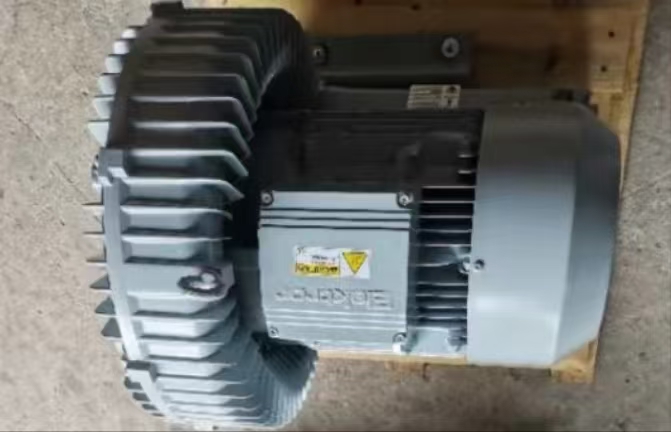
3. Where Vacuum Pumps Still Rule
Although side channel blowers are powerful, they have a physical limit: The ultimate vacuum level is not high.
Typically, a single-stage blower reaches about -20kPa to -40kPa, and a double-stage high-pressure model reaches only about -70kPa (relative vacuum). For example, the Elektror SD series can achieve a pressure difference of up to 75kPa and an airflow of 1150 m³/h.
If your scenario falls into the following categories, do not use a side channel blower:
High Vacuum Environments: (Lab distillation, vacuum coating, electron microscopes). These require removing 99% of air molecules. Blowers have gaps in the impeller, causing backflow.
Vacuum Packaging (Deoxygenation): (Food sealing). The goal is to prevent spoilage. Blowers leave too much residual air.
Deep Freeze Drying: (Pharmaceuticals). Requires extremely low pressure for sublimation, which blowers cannot achieve.
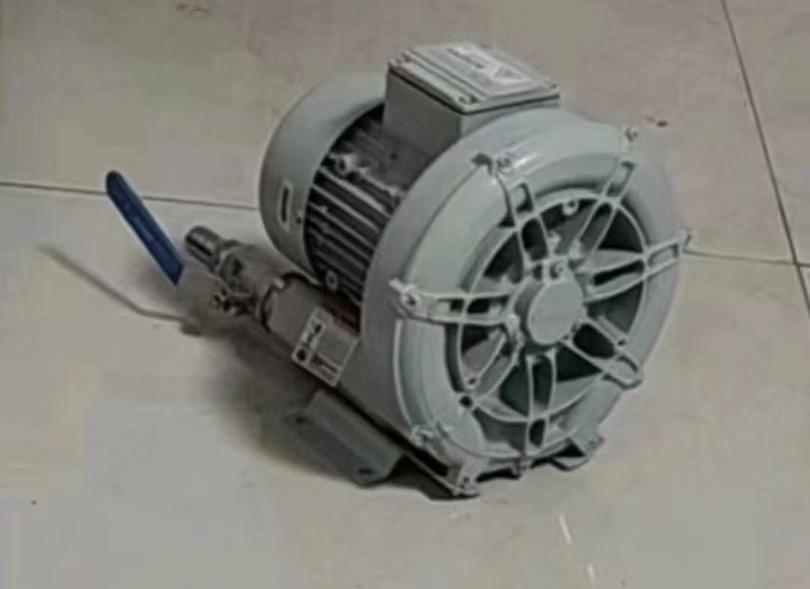
4. Summary: How to Choose?
Using a side channel blower as a vacuum pump comes down to "balancing Flow vs. Pressure."
Choose a Side Channel Blower: When you need to "hold things down," "suck away dust," or when the object is "leaky/permeable." It is cheap, oil-free, maintenance-free, and handles leaks well.
Choose a Traditional Vacuum Pump: When you need to "evacuate air completely," create an "anaerobic environment," or require "high vacuum."
Conclusion:
The "negative pressure" capability of side channel blowers can indeed replace small vacuum pumps under specific boundaries. In low vacuum, high flow, and complex medium scenarios, blowers often show better comprehensive benefits. However, for high vacuum, low flow, and strict cleanliness requirements, traditional vacuum pumps remain irreplaceable. While future technology may bring hybrid devices, current selection requires rigorous technical and economic analysis.